
Mount Kilimanjaro Umbwe Route – 5, 6 or 7 DaysChallenging Route
Description
Tackle one of Kilimanjaro's steepest and most direct approaches via the Umbwe Route. Best suited for experienced hikers, Umbwe ascends quickly through montane rainforest to the dramatic Barranco Valley, then joins the Southern Circuit toward Barafu for a night summit attempt on Uhuru Peak.
Choose between 5, 6 or 7 days: 5 days is a fast ascent with limited acclimatization, 6 days is the balanced standard itinerary, and 7 days adds an extra acclimatization day (usually at Karanga) to improve summit success. Fully supported trek with professional guides, porters, quality camping, meals and park fees included.
Route Highlights
Steep, direct ascent through pristine Umbwe rainforest
Join the Southern Circuit via the iconic Barranco Wall
Balanced acclimatization options: 5, 6 or 7 days itineraries
Sunrise summit attempt from Barafu to Uhuru Peak (5,895m)
Professional mountain guides, porters and full camp support
Day-by-Day Umbwe Route Itinerary
Day 1: Umbwe Gate (1,800 m) → Umbwe Cave Camp (2,850 m)
5–7 hours • 10–12 km • 1,800 m → 2,850 m • Steep ridge ascent
The Umbwe Route is Kilimanjaro’s most direct, most demanding, and least-travelled path to the summit — a route for experienced, fit trekkers who want a challenging, intimate mountain experience with minimal crowds. The trail begins at the Umbwe Gate after a transfer from Moshi or Arusha, and from the very first step it is clear this is not a casual walk: the path follows a narrow, steep ridge through dense montane rainforest with very little flat ground, gaining elevation at a rate that immediately tests both fitness and acclimatization tolerance. The forest on the Umbwe ridge is primeval and largely untouched — colobus monkeys crash through the ancient trees, rare orchids cling to mossy boulders, and the canopy closes tightly overhead, creating a dark, cool tunnel of green. The narrowness of the ridge path — sometimes only a metre wide with steep drops on both sides — requires concentration and sure-footedness throughout. Umbwe Cave Camp (2,850 m) is a compact, well-sheltered campsite beside a shallow rock overhang that gave the route its first historical bivouac site. Your porter team has camp set up on arrival; dinner is served as the forest settles into darkness around the ridge.
Accommodation: Umbwe Cave Camp (2,850 m) | Meals: Breakfast, Lunch & Dinner
Day 2: Umbwe Cave Camp (2,850 m) → Barranco Camp (3,960 m)
5–7 hours • 10 km • 2,850 m → 3,960 m
The second day continues the relentless ridge ascent, pushing through the upper forest, into the heather zone, and up to the moorland before reaching the dramatic Barranco Valley at 3,960 metres. This is one of the most sustained climbing days on Kilimanjaro in terms of both gradient and altitude gain — 1,110 metres in a single stage — and the Umbwe ridge demands constant focus as the terrain alternates between exposed rock scrambles, muddy forest sections, and open moorland. The transition from forest to heather zone reveals increasingly dramatic views of Kibo’s southern face, with the glaciers and ice fields glittering in the sun. Giant senecios appear on the moorland slopes, growing taller and more numerous as altitude increases, and the air becomes noticeably thinner above 3,500 metres. Arriving at Barranco Camp (3,960 m), at the head of the Great Barranco Valley with the iconic Barranco Wall looming directly above, marks the completion of the Umbwe ridge ascent and the convergence with the Southern Circuit routes. The camp is spectacular and the sense of achievement arriving here via the direct Umbwe approach is significant.
Accommodation: Barranco Camp (3,960 m) | Meals: Breakfast, Lunch & Dinner
Day 3: Barranco Camp → Karanga Camp 7-Day Plan Only
4–5 hours • 5 km • 3,960 m → 4,035 m
On the 7-day itinerary, today begins with the celebrated Barranco Wall scramble before traversing the Southern Circuit to Karanga Camp. The Barranco Wall is a 300-metre ascent of exposed volcanic rock — the most technically engaging and genuinely exciting section of the entire Southern Circuit — which despite its dramatic appearance is a non-technical scramble with good handholds and confident guide support throughout. The views from the top of the wall extend across the full arc of the Southern Circuit, with Kibo towering ahead and the vast plains of southern Tanzania visible far below. From the top of the wall, the trail traverses a series of rolling lava ridges before descending into the Karanga Valley and its seasonal glacial meltwater stream. Karanga Camp (4,035 m) is a sheltered ridge campsite with good sunset views and an extra night of acclimatization at this altitude before the final push to Barafu. On 5 and 6-day plans, trekkers continue directly from Barranco to Barafu without stopping at Karanga, compressing the acclimatization profile. The extra night at Karanga on the 7-day plan measurably improves summit success rates.
Accommodation: Karanga Camp (4,035 m) | Meals: Breakfast, Lunch & Dinner
Day 3/4: Barranco / Karanga → Barafu Camp
4–6 hours • 4–9 km • → 4,640 m
The ascent to Barafu Camp, the main high camp for the Umbwe Route, is a significant altitude push across the bare, rocky southern face of Kibo. From Barranco on the shorter plans, the trail first traverses the Barranco Wall scramble, crosses the Karanga Valley, and climbs the long volcanic ridge to Barafu in a single extended day. From Karanga on the 7-day plan, today is a shorter, focused half-day ascent directly to Barafu. Regardless of starting point, the final approach to Barafu is identical — a steep, exposed climb across fractured lava and volcanic scree with the oxygen level dropping measurably with every 100 metres of elevation gain. Barafu Camp (4,640 m) sits on a narrow, windswept ridge with steep drops on both flanks and Kibo’s summit cone filling the entire sky directly above. On clear afternoons, Mount Meru and the sweeping savannah of northern Tanzania are visible to the south. Your guide delivers the summit briefing in detail and serves dinner at 5:00 pm, after which complete silence and rest are essential. The next wake-up call comes at midnight.
Accommodation: Barafu Camp (4,640 m) | Meals: Breakfast, Lunch & Dinner
Day 4/5: Summit Night — Uhuru Peak (5,895 m) → Mweka Camp
12–16 hours • 4,640 m → 5,895 m → 3,100 m • The hardest day
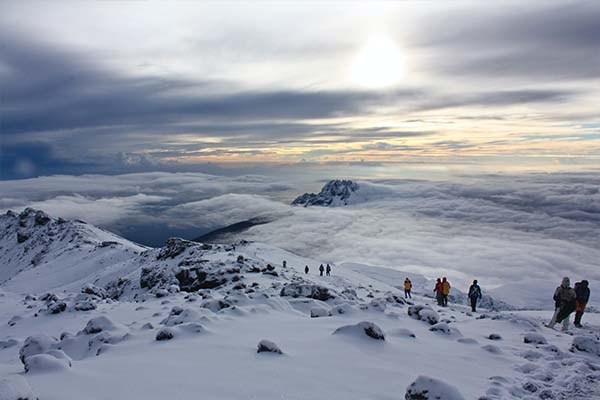
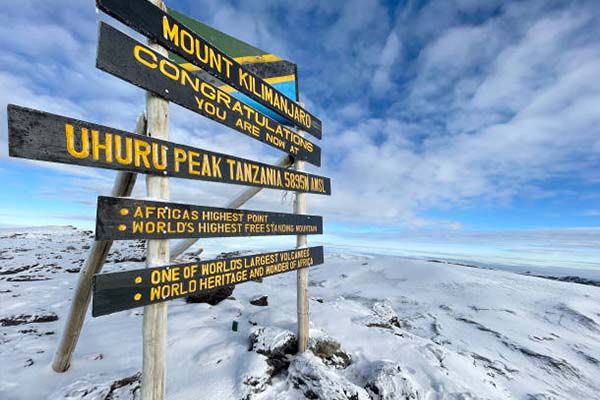
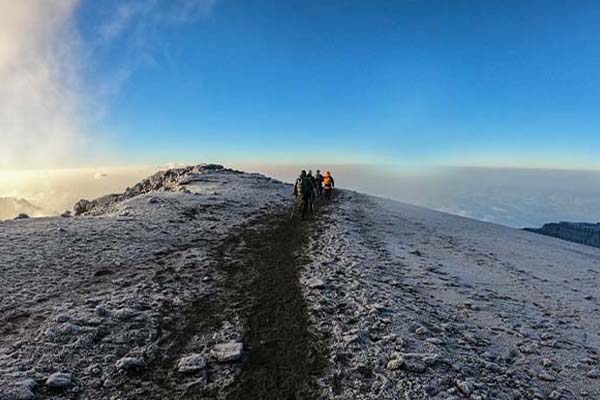
At midnight the summit push begins — the culmination of everything the Umbwe Route has built up to. The ascent is steep and unrelenting from the first step, switchbacking across the volcanic scree of Kibo’s crater wall in darkness and near-silence, with only headlamps, the crunch of boots on rock, and the sound of controlled breathing punctuating the effort. The Umbwe Route’s aggressive altitude gain means that summit day trekkers need strong mental resilience as well as physical fitness; the route’s lower acclimatization profile compared to Lemosho means that determination and steady breathing are critical tools. Stella Point (5,739 m) arrives at the crater rim as the first light breaks across Kenya to the east — a moment of profound beauty that rewards every step of the climb. The final traverse to Uhuru Peak (5,895 m) along the crater rim takes forty-five minutes and is completed in clear morning light. The summit of Africa, at the top of the world’s largest free-standing mountain, is a moment of extraordinary stillness, achievement, and perspective. Descent via the Mweka Route is rapid, reaching Mweka Camp (3,100 m) by late afternoon through alpine desert, moorland, and the upper forest zone.
Accommodation: Mweka Camp (3,100 m) | Meals: Breakfast, Lunch & Dinner
Day 5/6: Mweka Camp → Mweka Gate → Transfer
3–4 hours • 10 km • 3,100 m → 1,640 m
The final morning of the Umbwe Route begins with a celebration breakfast and a last walk through the lower montane forest to the Mweka Gate. The descent through the warm, oxygen-rich forest — with colobus monkeys, birdsong, and the lush green of the lower mountain surroundings — is a sensory feast after days on the barren upper mountain. The improved air quality at lower altitude is immediately perceptible, and sore legs seem lighter with each downward step. At the Mweka Gate (1,640 m), the official KINAPA sign-out and summit certificate ceremony concludes the climb — the gold Uhuru Peak certificate presented to those who reached the summit, and the green certificate for Gillman’s or Stella Point. The farewell with your porter and guide team is heartfelt and celebratory; the Umbwe Route’s smaller group size and shared intensity creates particularly strong bonds between trekkers and crew over the course of the climb. Tips are distributed, photographs are taken, and the team disperses. Transfer to Moshi or Arusha marks the completion of one of East Africa’s most demanding and rewarding mountain adventures.
Accommodation: N/A — Return to Moshi / Arusha | Meals: Breakfast & Lunch
Variations: 5 days (skip Karanga, go Barranco → Barafu), 7 days (add extra acclimatization night at Karanga before Barafu).
Includes & Excludes
Kilimanjaro park fees & camping fees
Professional mountain guide, porters & cook
Quality mountain tents, sleeping mats & mess tent
All meals on the mountain (breakfast, lunch, dinner)
Purified drinking water & hot beverages
Transfers to/from Umbwe Gate (Arusha/Moshi)
International flights & Tanzania visa fees
Personal trekking gear (boots, sleeping bag, clothing)
Travel insurance (mandatory for high-altitude trekking)
Tips for guide, porters & cook
Hotel accommodation before/after trek (unless specified)
Alcoholic beverages
Frequently Asked Questions
Best seasons are June–October and January–February. The long rains (March–May) and short rains (Nov–Dec) make trails slippery, especially on steep sections. Umbwe is demanding year-round; the added acclimatization of a 6–7 day plan improves summit success.
Mountain camping in high-quality tents with sleeping mats, mess tent and hot meals prepared by the camp cook. Pre/post-trek hotel nights in Arusha or Moshi can be arranged separately or included in custom packages.
Umbwe is steep, direct and best suited to experienced trekkers with good fitness and prior high-altitude exposure. First-time hikers should consider Machame or Lemosho (longer, better acclimatization). If choosing Umbwe, opt for 6–7 days for improved acclimatization.
Layered clothing system (base/mid/insulation), waterproof jacket & pants, trekking boots, warm hat & gloves, headlamp with spare batteries, hydration system, personal meds, and a four-season sleeping bag (–10°C comfort). We provide a detailed gear list upon booking.
Kilimanjaro is a high-altitude trek; minimum age recommendations vary by park policy and outfitter, typically 10–12+ with strong fitness and prior trekking experience. Umbwe's steep profile is generally not advised for children; Machame/Lemosho are better alternatives.
Kilimanjaro Trek Details
Route
Umbwe (Steep & Direct)
Duration
5 – 7 Days
Key Camps
Umbwe • Barranco • Karanga • Barafu • Mweka
Max Altitude
5,895m (Uhuru Peak)
Accommodation
Mountain Tents (Camping)
Start & Exit
Umbwe Gate • Mweka Gate
Best For
Experienced Trekkers • Small Groups
Trek Price
$Upon Request / Per Person
Price depends on route duration (5/6/7), group size & season
Why Book With Us
Expertise and Experience
Tailored Services
Comprehensive Planning
Client Satisfaction
24/7 Support
Contact Details
Mr. Yamat
Tour Operator
Call Us : +255 686 241 980
Email : info@safarismate.com
Related Kilimanjaro Routes
Price Upon Request
Price Upon Request
Price Upon Request
Price Upon Request