
Mount Kilimanjaro Marangu Route – 5 or 6 DaysClassic Hut Route
Description
Climb Kilimanjaro via the classic Marangu Route (Coca-Cola Route). This is the only route with hut accommodation — Mandara, Horombo and Kibo — making it a popular choice for first-time trekkers. The recommended 6-day plan adds an acclimatization day at Horombo to improve summit success.
Choose 5 or 6 days: 5 days is a quicker ascent with less acclimatization, while 6 days includes an extra night at Horombo and a day hike toward Mawenzi for better adaptation. Fully supported with experienced mountain guides, porters, meals, park fees and transfers.
Trek Highlights
Hut accommodation: Mandara, Horombo and Kibo
Gradual ascent via Marangu's southeast ridge
Optional acclimatization day at Horombo (6-day plan)
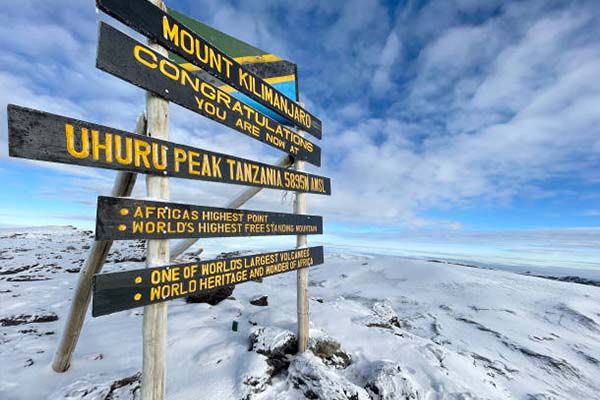
Summit attempt from Kibo Hut to Uhuru Peak (5,895m)
Experienced mountain guides, porters and meals included
Day-by-Day Marangu Route Itinerary
Day 1: Marangu Gate → Mandara Hut
3–5 hours • 8 km • 1,860 m → 2,720 m
Your Kilimanjaro adventure begins with a transfer from Moshi or Arusha to the Marangu Gate, where you complete park registration, meet your lead guide, and are introduced to your team of experienced porters. The trail immediately enters a lush montane rainforest — one of Kilimanjaro’s most biodiverse ecosystems — where ancient moss-draped trees form a dense canopy overhead and the air is cool and rich with birdsong. Black-and-white colobus monkeys swing between branches above the path, chameleons grip the undergrowth, and over 180 bird species fill the forest with colour and sound. The trail is well-maintained and rises gradually, making this an excellent introduction to high-altitude trekking and a comfortable warm-up for the days ahead. After three to five hours of pleasant walking, you arrive at Mandara Hut (2,720 m), a welcoming cluster of A-frame wooden cabins in a forest clearing. The huts offer bunk-bed dormitory accommodation, clean toilet facilities, and a communal dining room where your crew serves a hot dinner. Before dark, take the 30-minute loop trail to the spectacular Maundi Crater — a volcanic explosion pit just fifteen minutes from camp offering your first sweeping views of the Kilimanjaro foothills.
Accommodation: Mandara Hut (2,720 m) | Meals: Breakfast, Lunch & Dinner
Day 2: Mandara Hut → Horombo Hut
5–6 hours • 12 km • 2,720 m → 3,720 m
After breakfast at Mandara, the trail climbs steadily out of the rainforest and transitions into the dramatic heather-moorland zone, one of the most visually striking landscapes on the mountain. Enormous tree heathers draped in pale lichen line the path, giant groundsels (Senecio kilimanjari) tower above the trail like prehistoric sculptures, and knee-high tussock grasses stretch across the rolling hillsides. The path opens out to reveal the first breathtaking views of Kibo’s glaciated summit and the jagged volcanic spires of Mawenzi rising to the east. This is the longest day on the Marangu Route, covering twelve kilometres with a 1,000-metre elevation gain, so maintaining a slow, steady pace with regular water stops is essential. As you rise above 3,000 metres, your body begins to respond to thinner air — deeper breathing, possible mild headache, and slightly reduced energy are all normal and should be respected rather than ignored. Horombo Hut (3,720 m), the largest and most comfortable hut complex on Kilimanjaro, sits in a broad moorland bowl with panoramic views of both Kibo and Mawenzi. Warm dormitory huts, hot meals, flush toilets, and the famous colony of bold white-necked ravens make Horombo feel like a genuine mountain lodge after a long day on the trail.
Accommodation: Horombo Hut (3,720 m) | Meals: Breakfast, Lunch & Dinner
Day 3: Acclimatization Day at Horombo — Day Hike to Mawenzi Tarn 6-Day Plan Only
3–4 hours • Acclimatization hike • 3,720 m → ~4,330 m and return
On the 6-day itinerary, today is a dedicated acclimatization rest day at Horombo — arguably the single most important investment in your summit success. The principle is “climb high, sleep low”: ascending to a higher elevation during the day stimulates your body to produce additional red blood cells and adapt to thinner air, while sleeping at your existing altitude accelerates recovery. The recommended hike follows the trail northeast toward the dramatic Mawenzi Tarn, a glacial lake cradled beneath Mawenzi’s jagged volcanic spires at approximately 4,330 metres. The landscape becomes increasingly surreal as you gain elevation — the giant senecios give way to bare volcanic rock, frosted cushion plants, and an eerie silence broken only by the wind. The views of Kibo from the tarn are outstanding, giving you a clear sense of the scale of the summit push ahead. Return to Horombo for a hot lunch and a relaxed afternoon of rest, rehydration, and equipment preparation. Research consistently shows that trekkers on the 6-day Marangu plan achieve summit success rates 15–20% higher than those on the 5-day option. 5-day trekkers proceed directly from Day 2 to Kibo Hut, skipping this acclimatization stage.
Accommodation: Horombo Hut (3,720 m) | Meals: Breakfast, Lunch & Dinner
Day 3/4: Horombo Hut → Kibo Hut
5–7 hours • 15 km • 3,720 m → 4,700 m
Departing Horombo after an early breakfast, the trail crosses the famous “Saddle” — a sweeping, desolate plateau stretching between Mawenzi to the east and Kibo to the west. Vegetation thins dramatically to scattered tufts of everlasting flowers and isolated cushion plants, then disappears entirely as the trail enters a raw alpine desert of loose volcanic scree, fragmented lava, and windswept dust. At this altitude, every breath delivers roughly 55% of the oxygen available at sea level, and the constant sound of wind across the plateau creates an otherworldly atmosphere that focuses the mind completely. The last section to Kibo Hut is a long, exposed traverse across open moraine with Kibo’s imposing summit cone filling the entire skyline ahead — a sight that is simultaneously inspiring and sobering. Kibo Hut (4,700 m) is a stone dormitory, deliberately spartan — basic metal bunk beds, limited water, and pit latrines — because it is purely a launch pad, not a comfortable rest stop. Your guides serve a simple early dinner at 5:00 pm, walk you through summit procedure in detail, and firmly encourage you to be horizontal in your sleeping bag by 6:00 pm. Rest even if sleep is impossible; your body and mind need every reserve of energy for the most demanding challenge of the climb.
Accommodation: Kibo Hut (4,700 m) | Meals: Breakfast, Lunch & Dinner
Day 4/5: Summit Night — Uhuru Peak (5,895 m) → Descent to Horombo
10–14 hours • 4,700 m → 5,895 m → 3,720 m • The hardest day
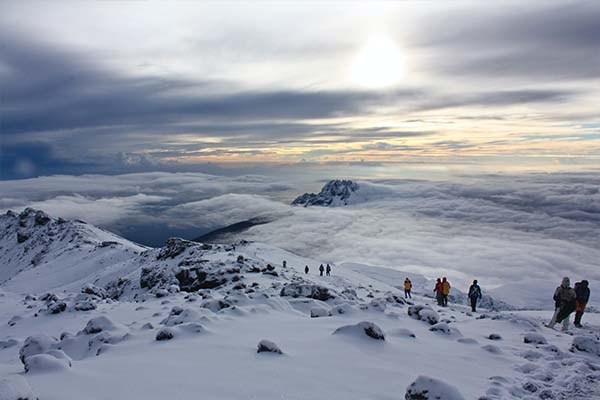
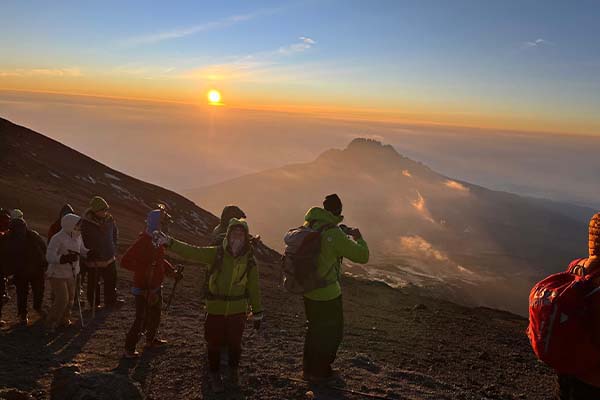
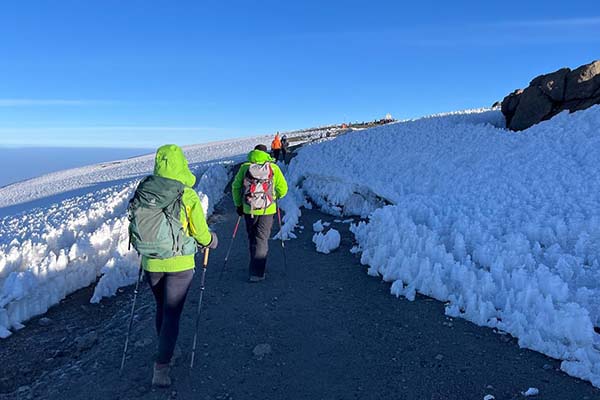
At midnight (or 1:00 am), your guide wakes the group for the summit push — the most physically and emotionally demanding stretch of the entire climb. Dressed in every layer you carry and with headlamps cutting through the silent darkness, you begin the steep ascent on loose scree, switch-backing methodically across the crater wall. The pace is extraordinarily slow — at times a single step every two seconds — as each breath delivers a fraction of the oxygen your body demands and the temperature can drop to −15°C or below. Passing Hans Meyer Cave at around 5,100 metres, the gradient steepens toward Gillman’s Point (5,681 m) at the crater rim, where the first golden light of dawn often breaks across the Kenyan plains far below — one of the most moving moments in African trekking. From Gillman’s Point the trail traverses the crater rim with the vast ice fields and the active ash pit visible below, continuing past Stella Point (5,739 m) before the final, gentler rise to Uhuru Peak (5,895 m) — the highest point in Africa. After photographs, tears of joy, and a moment of profound silence, the descent must begin without delay. The scree-run back to Kibo Hut takes 2–3 hours; after a brief rest and a warm drink, continue descending through the Saddle, past Horombo junction, and all the way down to Horombo Hut by mid-afternoon, where a hot meal and a bunk await.
Accommodation: Horombo Hut (3,720 m) | Meals: Breakfast, Lunch & Dinner
Day 5/6: Horombo Hut → Marangu Gate → Transfer
5–6 hours • 18 km • 3,720 m → 1,860 m
The final descent is a triumphant journey back through all of Kilimanjaro’s ecological zones. Leaving Horombo after an early breakfast, the trail crosses back through the moorland, re-enters the cool and mossy rainforest, and eventually reaches the lower forest boundary at Mandara before the final push to the gate. Despite tired legs and the cumulative fatigue of the climb, most trekkers find renewed energy on this day, propelled by the quiet elation of their achievement. Eighteen kilometres of gentle downhill trail pass quickly over five to six hours. At the Marangu Gate, the KINAPA park staff conduct the final sign-out procedure and issue the coveted Kilimanjaro summit certificate — a green certificate for reaching Gillman’s Point, and the prestigious gold certificate for those who reached Uhuru Peak. Your crew gathers for a farewell ceremony, photographs are taken with the guide and porter team, and tips are distributed as a heartfelt acknowledgement of their extraordinary support. Transfer back to Moshi or Arusha, where a hot shower, a full meal, and a comfortable bed mark the end of one of the most rewarding physical experiences on the African continent.
Accommodation: N/A — Return to Moshi / Arusha | Meals: Breakfast & Lunch
Includes & Excludes
Kilimanjaro park fees and hut accommodation fees
Certified mountain guide, porters and cook
All meals on the mountain (breakfast, lunch, dinner)
Drinking water during the trek
Transfers: Moshi/Arusha ↆMarangu Gate
Rescue fees and government taxes
International flights and Tanzania visa
Travel & medical insurance (mandatory)
Personal trekking gear (boots, clothing, sleeping bag)
Hotels before/after trek and meals in town
Tips for crew (guide, porters, cook)
Optional personal snacks and alcoholic beverages
Frequently Asked Questions
The best seasons are June–October and January–March for stable weather and clearer skies. Marangu huts operate year-round. Expect cold nights near Kibo and potential rains in April–May and November. We'll advise the ideal window based on your dates.
This route uses mountain huts: Mandara, Horombo and Kibo. Dorm-style rooms with bunk beds; shared dining halls and basic washrooms. Mattresses are provided; bring a warm sleeping bag and personal toiletries. Meals are cooked by our mountain crew.
Marangu is considered moderate with a gradual approach but a long summit night. The 6-day itinerary adds an acclimatization day, improving success rates. Suitable for fit first-timers; regular training (hikes, cardio) and proper gear are important.
Essential items: sturdy trekking boots, layered clothing, waterproof jacket/pants, warm hat and gloves, headlamp with spare batteries, trekking poles, SPF sunscreen, 3L hydration system, personal meds, and a 4-season sleeping bag. A detailed packing list will be provided.
We generally recommend Kilimanjaro treks for ages 12+ with good fitness. Altitude affects everyone differently; minors must trek with a responsible adult and follow guide advice. Contact us to assess suitability for your family and choose the right plan.
Kilimanjaro Trek Details
Route
Marangu Route (Coca-Cola Route)
Duration
5 or 6 Days
Huts
Mandara • Horombo • Kibo
Max Altitude
Uhuru Peak (5,895 m)
Accommodation
Mountain huts (shared dorms)
Start & Exit
Marangu Gate
Best For
First-time trekkers seeking hut comfort
Trek Price
$Upon Request / Per Person
Price depends on route choice, group size & season
Why Book With Us
Expertise and Experience
Tailored Services
Comprehensive Planning
Client Satisfaction
24/7 Support
Contact Details
Mr. Yamat
Tour Operator
Call Us : +255 686 241 980
Email : info@safarismate.com
Related Kilimanjaro Routes
Price Upon Request
Price Upon Request
Price Upon Request
Price Upon Request