
Mount Kilimanjaro Machame Route – 6, 7 or 8 DaysScenic Camping Route
Mountain Trek (Camping Route)
Machame • Shira • Barranco • Karanga • Barafu • Mweka • Uhuru Peak
Description
Climb Kilimanjaro via the scenic Machame (Whiskey) Route. This classic camping trek offers excellent acclimatization through climb-high, sleep-low profiles and iconic features like the Barranco Wall. The recommended 7–8 day plans add an acclimatization day to improve summit success.
Choose 6, 7 or 8 days: 6 days is the quicker ascent; 7–8 days add acclimatization at Karanga or via an extra night between Shira and Barranco for improved success. Fully supported with experienced mountain guides, porters, meals, park fees and transfers.
Trek Highlights
Camping route: Machame, Shira, Barranco, Karanga, Barafu; Mweka exit
Climb-high, sleep-low profile via Lava Tower and Barranco
Optional acclimatization day at Karanga (7–8 day plans)
Summit attempt from Barafu to Uhuru Peak (5,895m)
Experienced mountain guides, porters and meals included
Day-by-Day Machame Route Itinerary
Day 1: Machame Gate → Machame Camp
5–7 hours • 11 km • 1,800 m → 3,000 m
The Machame Route begins with a transfer from Moshi or Arusha to the Machame Gate, where registration, safety briefings, and the all-important introduction to your guide and porter team take place. From the gate, the trail dives immediately into one of the densest sections of Kilimanjaro’s montane rainforest — a cathedral-like environment of giant podocarpus trees, ancient fig trees hung with curtains of lichen, and an understorey thick with ferns, wild begonias, and flowering impatiens. The ground is often muddy and the air heavy with moisture; gaiters and trekking poles are highly recommended from the start. Colobus monkeys crash through the canopy, sunbirds dart through the flowers, and the calls of Hartlaub’s turaco echo from the treetops. The trail climbs consistently for eleven kilometres, gaining 1,200 metres of elevation over five to seven hours of trekking. Arriving at Machame Camp (3,000 m), a popular and well-equipped campsite in a forest clearing, your porter team will have already erected your tents, prepared hot washing water, and begun cooking a substantial dinner. The first evening at camp, with the temperature dropping and the stars emerging above the forest canopy, sets the tone for a truly immersive mountain experience.
Accommodation: Machame Camp (3,000 m) | Meals: Breakfast, Lunch & Dinner
Day 2: Machame Camp → Shira Camp
4–6 hours • 9 km • 3,000 m → 3,840 m
After breakfast, the trail climbs steeply out of the upper forest edge and emerges into the heather-moorland zone, where the vegetation transforms dramatically into vast heather bushes, giant lobelias, and scattered Senecio kilimanjari towering three to four metres above the path. The change in landscape is sudden and striking — within an hour, the dense green forest gives way to an open, wind-swept moorland with expansive views across the Southern Tanzanian plains. The trail continues rising through rocky ridges and across shallow valleys, with Kibo’s glaciated summit cone coming into full view for the first time, filling the northern skyline with its immense presence. The route eventually crests onto the ancient Shira Plateau, the remnant caldera of a long-collapsed volcanic cone that forms a vast, flat lava field at 3,840 metres. Shira Camp sits in the south-eastern corner of this plateau, offering sweeping 360-degree views and a powerful sense of standing on the roof of a continent. Your porter team has set camp, and as the temperature drops sharply after sunset, hot soup, a three-course dinner in the mess tent, and warm sleeping bags make the evening thoroughly comfortable.
Accommodation: Shira Camp (3,840 m) | Meals: Breakfast, Lunch & Dinner
Day 3: Shira Camp → Barranco Camp via Lava Tower
6–8 hours • 10 km • 3,840 m → 4,600 m → 3,960 m
Today is the defining acclimatization day of the Machame Route and one of the most rewarding days on the mountain. Leaving Shira Camp, the trail ascends steadily across the Southern Circuit path toward the Lava Tower, a dramatic 300-metre volcanic plug that rises incongruously from the rocky alpine desert at 4,600 metres. The “climb high, sleep low” principle is in full effect — reaching the Lava Tower at noon pushes your body to acclimatize to near-summit conditions, while the afternoon descent to Barranco at 3,960 metres allows recovery at a more comfortable sleeping altitude. The landscape between Shira and Lava Tower is strikingly beautiful: cushion plants, lobelia and senecio give way to bare volcanic boulders, hanging glaciers visible to the north, and sweeping views that extend to the Kenyan border on a clear day. The descent from Lava Tower into the spectacular Barranco Valley reveals a dramatically different face of the mountain — a deep glacial valley ringed by towering volcanic cliffs, with the iconic Great Barranco Wall — tomorrow’s challenge — rising 300 metres directly above camp. Barranco Camp (3,960 m) is one of the most atmospheric campsites on the entire mountain.
Accommodation: Barranco Camp (3,960 m) | Meals: Breakfast, Lunch & Dinner
Day 4: Barranco Camp → Karanga Camp (7-day) or Barafu Camp (6-day)
4–6 hours • 5–9 km • 3,960 m → 4,035 m or 4,640 m
The day begins with the famous Barranco Wall — a 300-metre scramble up exposed volcanic rock that is the most exciting and technically engaging section of the entire Machame Route. Despite its intimidating appearance from below, the wall is a non-technical scramble with good handholds and footholds throughout, and your guide leads the way with complete confidence. The ascent takes approximately 45 minutes to an hour and the views from the top are extraordinary — the full curve of the Southern Circuit spread below, Kibo towering ahead, and the vast lowlands of Tanzania visible in every direction. From the top of the wall, the trail traverses a series of rolling ridges and valleys across the Southern Circuit path, passing the dramatic Karanga Valley junction with its seasonal meltwater stream. On the 7-day itinerary, today ends at Karanga Camp (4,035 m), a sheltered site with water access and another acclimatization benefit before the final push to base camp. On the 6-day plan, trekkers continue directly up from Karanga to Barafu Camp (4,640 m) — the main high camp — arriving in the early afternoon with time to rest and prepare for the midnight summit push.
Accommodation: Karanga Camp (4,035 m) — 7-day | Barafu Camp (4,640 m) — 6-day | Meals: Breakfast, Lunch & Dinner
Day 5: Karanga Camp → Barafu Camp 7-Day Plan Only
3–4 hours • 4 km • 4,035 m → 4,640 m
On the 7-day itinerary, today is a short but purposeful half-day stage from Karanga Camp to Barafu Camp, the main base camp for the Machame Route summit push. The trail climbs steadily through increasingly barren volcanic terrain, where the last traces of vegetation disappear and the landscape becomes a raw moonscape of scree, lava rock, and loose ash. Barafu Camp (4,640 m) — its name means ‘ice’ in Kiswahili — sits on an exposed rocky ridge with an almost vertical drop on one side and Kibo’s summit cone looming directly above. Arriving by early afternoon allows maximum rest time before the midnight start. Your guide walks you through the summit plan in detail: the route, the timing, what to wear, how to manage cold and fatigue, and when to turn back if necessary. A filling early dinner is served at 5:00 pm, after which the camp falls quiet by 7:00 pm. The short hours of preparation, rest, and mental readiness at Barafu are among the most important of the entire climb.
Accommodation: Barafu Camp (4,640 m) | Meals: Breakfast, Lunch & Dinner
Day 5/6: Summit Night — Uhuru Peak (5,895 m) → Mweka Camp
12–16 hours • 4,640 m → 5,895 m → 3,100 m • The hardest day
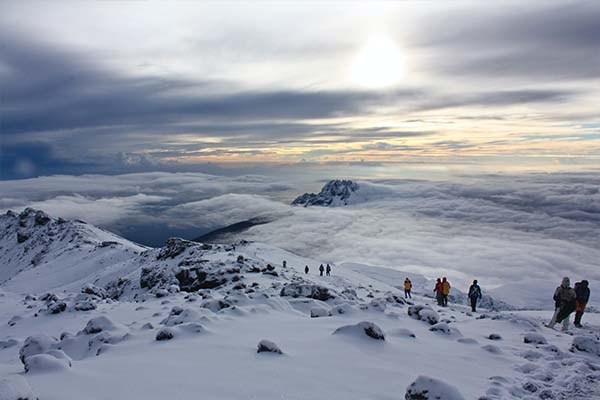
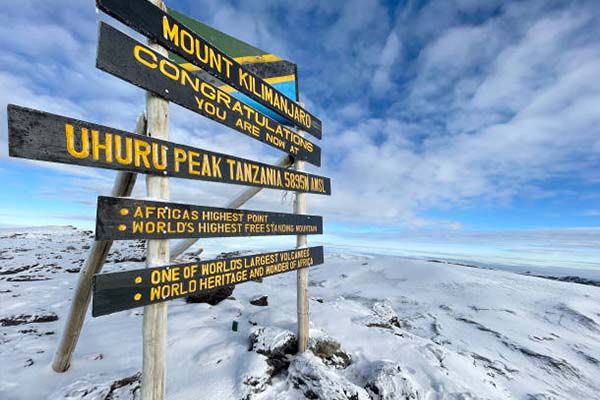
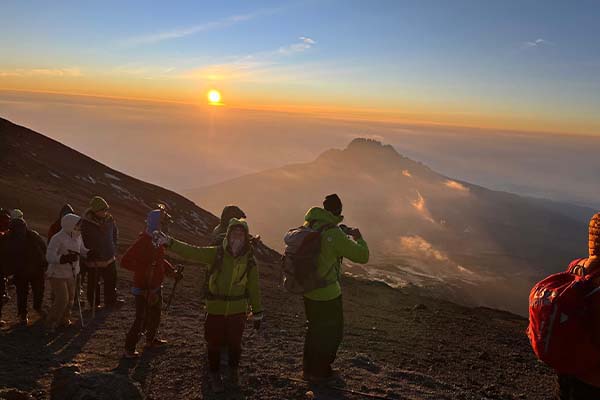
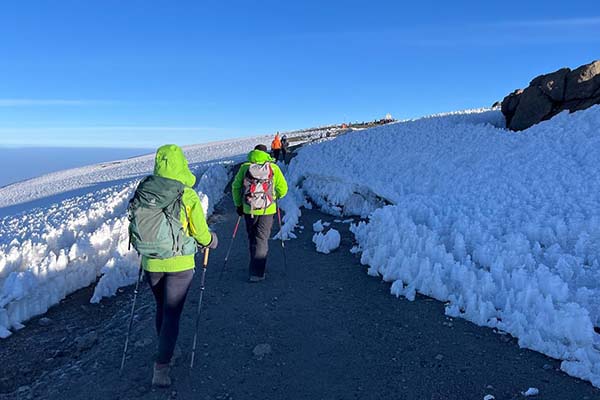
The summit push begins at midnight or 1:00 am, under a vast canopy of equatorial stars at 4,640 metres. Fully layered against temperatures that can fall below −15°C, and with headlamps lighting a path across endless volcanic scree, you begin the steep ascent toward the crater rim. The pace is deliberately glacial — one deliberate step at a time — as altitude reduces the available oxygen to approximately 50% of sea-level concentration and every step demands conscious effort and controlled breathing. The trail switchbacks relentlessly through darkness, passing Stella Point (5,739 m) on the crater rim just as the first pale light of dawn begins to separate the sky from the earth. From Stella Point, the route follows the crater rim with the spectacular Southern Glaciers to the left and the vast ash pit of the volcano below, arriving at Uhuru Peak (5,895 m) — the highest point in Africa and the top of the world’s tallest free-standing mountain. The views, the silence, the cold, and the improbable beauty of the moment are unlike anything else available on the African continent. After photographs and a brief, triumphant rest, the descent begins immediately via the Mweka Route — a different, steeper path that descends swiftly to Mweka High Camp and then to Mweka Camp (3,100 m), where your porters serve a celebration dinner and you sleep for the first time below the altitude of altitude sickness.
Accommodation: Mweka Camp (3,100 m) | Meals: Breakfast, Lunch & Dinner
Day 6/7: Mweka Camp → Mweka Gate → Transfer
3–4 hours • 10 km • 3,100 m → 1,640 m
The final morning on the mountain begins with a hearty breakfast before the last descent through the montane rainforest to the Mweka Gate. The trail drops steeply through the lower forest zone, re-entering the warm, oxygen-rich air of the lower altitude with a tangible sense of relief and accomplishment. Colobus monkeys return to the canopy, the forest thickens, and the scent of damp earth and vegetation is a sensory welcome back to the world below the snowline. At the Mweka Gate (1,640 m), the final sign-out and summit certificate ceremony takes place — the prestigious gold Uhuru Peak certificate is presented to those who reached the summit, and the green Gillman’s Point certificate to those who reached the crater rim. Your crew assembles for a farewell celebration: singing, photographs, expressions of mutual pride, and the distribution of tips as a deeply appreciated recognition of the extraordinary physical labour and dedication of your porter and guide team. Transfer to Moshi or Arusha, where the comforts of a shower, a restaurant meal, and a real bed have rarely felt so well-earned.
Accommodation: N/A — Return to Moshi / Arusha | Meals: Breakfast & Lunch
Includes & Excludes
Kilimanjaro park fees and camping fees
Certified mountain guide, porters and cook
All meals on the mountain (breakfast, lunch, dinner)
Drinking water during the trek
Transfers: Moshi/Arusha ↆMachame Gate / Mweka Gate
Rescue fees and government taxes
International flights and Tanzania visa
Travel & medical insurance (mandatory)
Personal trekking gear (boots, clothing, sleeping bag)
Hotels before/after trek and meals in town
Tips for crew (guide, porters, cook)
Optional personal snacks and alcoholic beverages
Frequently Asked Questions
The best seasons are June–October and January–March for stable weather and clearer skies. Expect cold nights near Barafu and potential rains in April–May and November. We'll advise the ideal window based on your dates.
Machame is a camping route. We provide four-season tents, sleeping mattresses and hot meals prepared by our mountain crew. There are no huts along the Machame trail. Bring a warm sleeping bag and personal toiletries.
Machame is considered moderate to challenging with a rewarding climb-high, sleep-low profile. The 7–8 day itineraries improve acclimatization and success. Suitable for fit trekkers; regular training (hikes, cardio) and proper gear are important.
Essential items: sturdy trekking boots, layered clothing, waterproof jacket/pants, warm hat and gloves, headlamp with spare batteries, trekking poles, SPF sunscreen, 3L hydration system, personal meds, and a 4-season sleeping bag. A detailed packing list will be provided.
We generally recommend Kilimanjaro treks for ages 12+ with good fitness. Altitude affects everyone differently; minors must trek with a responsible adult and follow guide advice. Contact us to assess suitability for your family and choose the right plan.
Kilimanjaro Trek Details
Route
Machame Route (Whiskey Route)
Duration
5 or 6 Days
Huts
Machame • Shira • Barranco • Karanga • Barafu • Mweka
Max Altitude
Uhuru Peak (5,895 m)
Accommodation
Mountain huts (shared dorms)
Start & Exit
Marangu Gate
Best For
First-time trekkers seeking hut comfort
Trek Price
$Upon Request / Per Person
Price depends on route choice, group size & season
Why Book With Us
Expertise and Experience
Tailored Services
Comprehensive Planning
Client Satisfaction
24/7 Support
Contact Details
Mr. Yamat
Tour Operator
Call Us : +255 686 241 980
Email : info@safarismate.com
Related Kilimanjaro Routes
Price Upon Request
Price Upon Request
Price Upon Request
Price Upon Request